

Hey there 👋
If you’re new — welcome. Many of you found Gaapsavvy because you registered for the April 17 session with Adam Dix from Anthropic’s finance team. I’m glad you’re here, because what I want to write about today is something I’ve been carrying for eight years and didn’t have the proof for until last month.
This room came together because of one question that kept coming up at our March shareforum — over and over, in the chat, in the polls, after the session: “How is anyone actually using Claude Code and Cowork in a real finance workflow?”
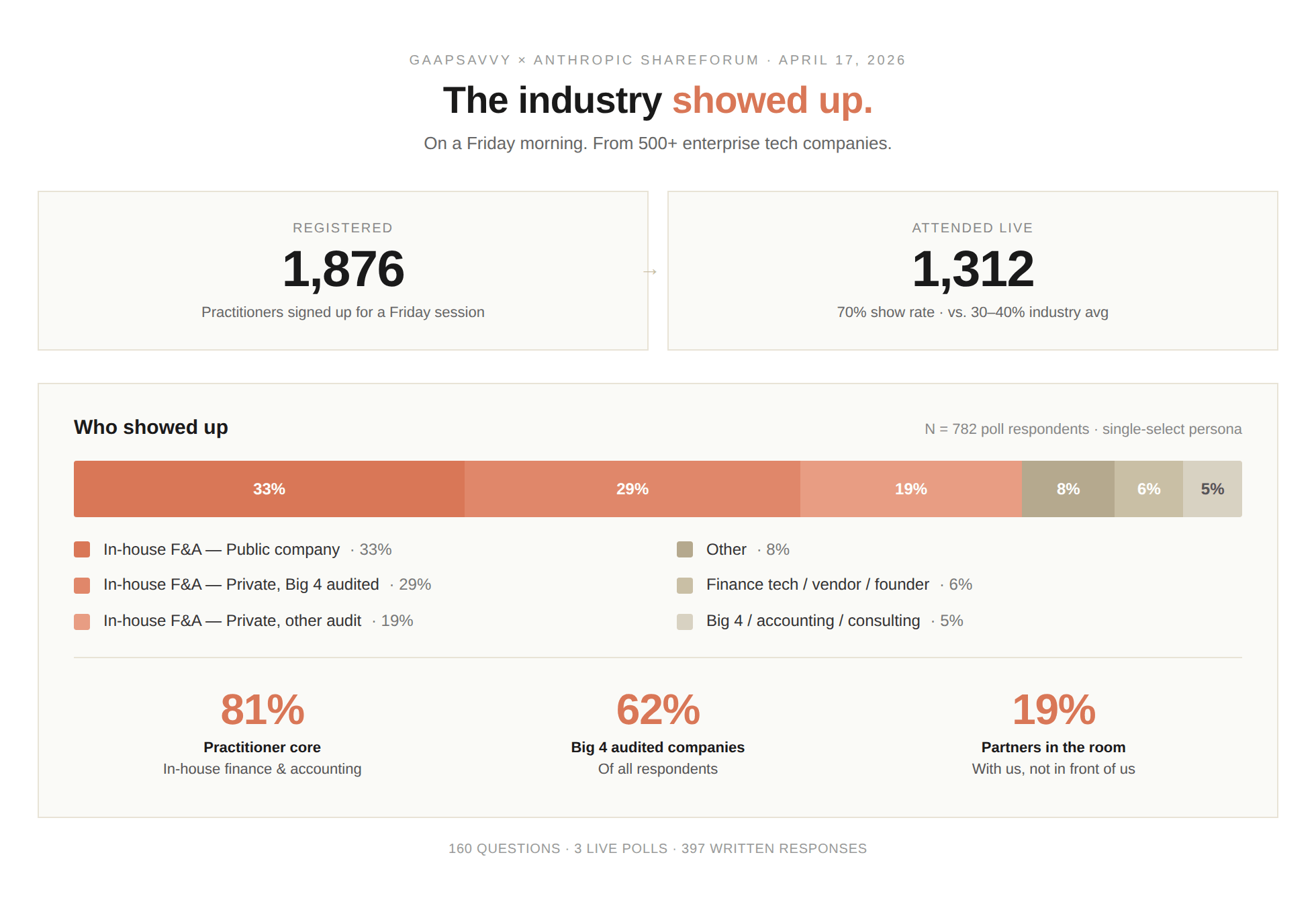
On April 17, we ran a session. Adam would show what his team had built with Claude. Our community would ask questions. 1,876 registered. 1,312 showed up on a Friday morning, from roughly 500 enterprise tech companies. 81% were in-house finance and accounting, and of those 77% audited by the Big 4.
Adam generously shared how he started experimenting, accumulated context in projects, asked Claude where to start, working ‘side by side’ with Claude Code, and built things that actually worked. He shared the whole journey — including where he got stuck, and the parts that surprised him.
Live attendees submitted 160 questions, answered three live polls, and produced — what I can only describe as a practitioner-generated product roadmap for production AI in enterprise accounting.
That’s not a webinar. That’s an industry showing up.
This is the article where I finally say what I think we built. And what I think we should do with this moment.
Let’s dive in.
This newsletter is generously sponsored by Zuora, the leading Quote to Cash Platform for Growth.

The problem: A one way street with no feedback loop
Eight years ago I sketched a diagram I never published. It’s still on my desk.
At the top: standard setters who write the rules. The Big 4 who interpret and audit. The software vendors who build. The firms and vendors partner across the middle — go-to-market motions, advisory engagements, audit tech.
At the bottom: in-house industry accounting teams. The practitioners.
Every arrow flows one direction. Down. Standards flow down. Interpretation flows down. Functionality flows down. Everybody tells industry accountants what “right” looks like, how they should think, what they should buy. Only the operators hold the translation of what any of this looks like day to day — how to fit the pieces together when the close is in three days and the auditor is on the calendar and the CFO needs the variance explained by Friday.
The missing piece: there is no arrow flowing up.
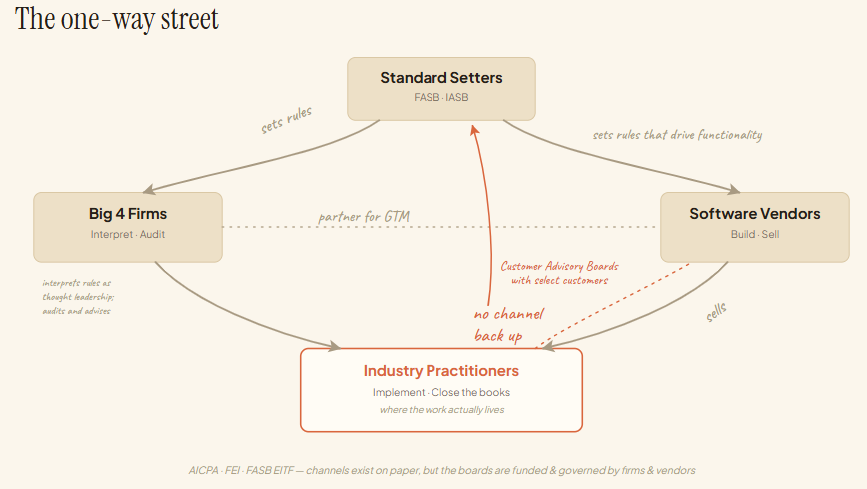
The upward channels technically exist. AICPA committees. FEI. FASB’s EITF. There are practitioner seats — but the boards are governed by the firms and vendors who fund them, and membership skews to the largest public companies with 15-person technical accounting teams. The companies where the emerging issues actually live — pre-IPO SaaS, AI-native startups, the private companies doing things the guidance hasn’t caught up with — have no meaningful representation. And all the outcomes are documented by firms and software vendors.
Even inside the firms, the pipes were always human. When I was in L&D at KPMG’s National Office, distributing knowledge consistently across 40,000 professionals was nearly impossible. Trainings were developed over months and delivered once a year. Interpretations were delivered through disparate publications. Signal from the field moved through networks, friends, chance coffee, DMs.
This barely worked when technology transitions took a decade. It shatters with the exponential pace of AI.
Here is the diagnosis, and I want to say it plainly because the empathy in this article only works if the diagnosis is honest. Well-meaning interpretation is being written as thought leadership by people who have never implemented. Software is being written by developers who have never closed the books. The practitioners — the only ones who could bridge both — have no time and no structural channel to push back through. Not because anyone is acting in bad faith. Because the mechanisms were never built.
And both of those interpretations — through thought leadership and through software — are quietly becoming the training data for the AI models the entire profession will be using by next year.
We are not writing what the models learn. They are.
Why Gaapsavvy exists
I started Gaapsavvy when ASC 606, the ‘new’ revenue recognition standard was rolling out. Nobody knew what to do, but everyone had to pretend they did. Each Big 4 firm sent up to 500 open questions to the SEC. The firms were interpreting in parallel with us, often disagreeing with each other depending on which one you sat across the table from.
Practitioners were figuring it out in real time, in isolation, with no one to compare notes with. Sometimes the most important thing to know, is when an answer had not yet been defined yet, and I thought: we get to the answer faster together than alone.
That’s still why we’re here. Except now things are moving way faster with AI.
A new layer needed to exist where industry operators — the people who bridge technical accounting and systems — could connect, exchange ideas, and iterate together. A human network built for ambiguous, large-scale change. A place to give voice to the operator who sees, feels, and lives the whole picture.
Throughout my career, I’ve sat in three seats in this ecosystem — the National Office at KPMG, writing trainings to audit a profession I didn’t live in yet; an industry technical accountant at Glassdoor, where I was humbled by how much harder it was to implement a repeatable process than to write a memo; and building software as part of the founding team at Everest, where I learned that accounting software fails at the infrastructure layer because accounting itself is a memory discipline that needs to be built on a time series — and nobody outside of the profession recognizes it as one.
Each seat sees a slice. None sees all three. The operator who lives all of it — every day, under pressure, with the audit and the close and the CFO all in the same week — sees the whole picture and has no structural way to say so.
Gaapsavvy was built for that operator.
Writing the future
Here’s what’s actually new. Operators are becoming builders. Writing is becoming creating.
For most of professional history, knowledge has been organized around the limits of our human capacity.
Just like medicine has neurologists, cardiologists and dermatologists, we had technical accounting, audit, internal controls, SEC reporting and finops. Each specialty exists because no one head could hold all of it - particularly in enterprise environments as companies scaled and compliance needs increased.
The Controller became the connective tissue, paying a translation cost every time something complex needed to cross a boundary. Aggregating, cleaning and synthesizing data as it came together. Accountants have to explain ASC 606 to a product engineer, then explain the engineer’s response to the auditor, then explain the auditor’s response to the CFO. The auditor who takes a screenshot of a dashboard because they cannot reason about the database underneath it. A software implementation is delayed because the vendor needs the technical accountant to validate an interpretation but waits months for a partner to work the conversation through the national office. Every cross-functional finance conversation has hours of translation overhead embedded in it that produces zero financial value. Nobody tracks the cost. Everybody pays it.
AI is the first technology that meaningfully lowers that translation cost. Not because it replaces specialists — because it lets the integrated practitioner finally act on the whole picture without losing it in translation. The profession isn't being automated. It's being un-fragmented. And the wisdom that has always lived in the operator who does the whole job — and was always lost in the handoff — is finally distributable. We can write it down. We can share it. We can make it count.
And just like it was when ASC 606 was being adopted, no one has the answers yet. We are making it up in real time.
You can see it in one hour
You don’t have to take my word for any of this. You can watch it happen in real time.
Some context for what the April 17 numbers mean. Gaapsavvy runs a shareforum every other month and has for eight years. In 2025, the average was 105 live practitioners per session out of ~150 RSVPs — a 75% show rate, in a profession where 30-40% is industry standard. 100% in-house, no vendors in the room. Across seven sessions, that’s 700+ hours of practitioner discussion. April 17 wasn’t a one-off. It was the same engine running at a bigger throttle, with a higher-profile speaker and a topic the entire industry was figuring out. The room knew how to show up because the room has been showing up.
1,312 attendees. ~500 corporate domains. 81% in-house finance. 160 questions. Three live polls. Read together, they show the shape of the problem the profession is facing.
Poll one — model approval
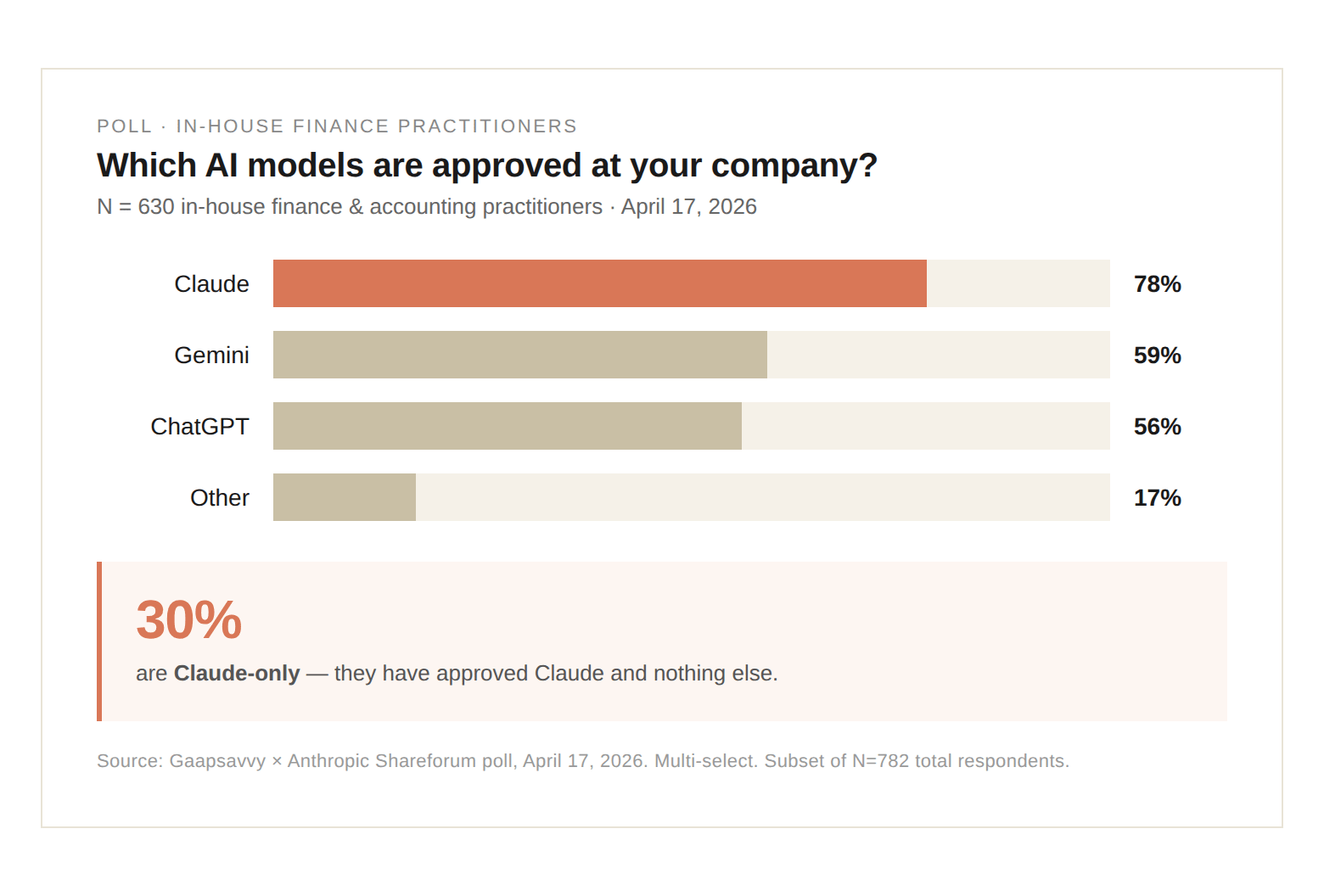
78% of in-house finance practitioners had Claude approved at their company. 56% had ChatGPT approved. 30% were Claude-only. In the subset of practitioners leaning in enough to show up on a Friday morning, the model landscape has already tipped.
Poll two — Claude capabilities used
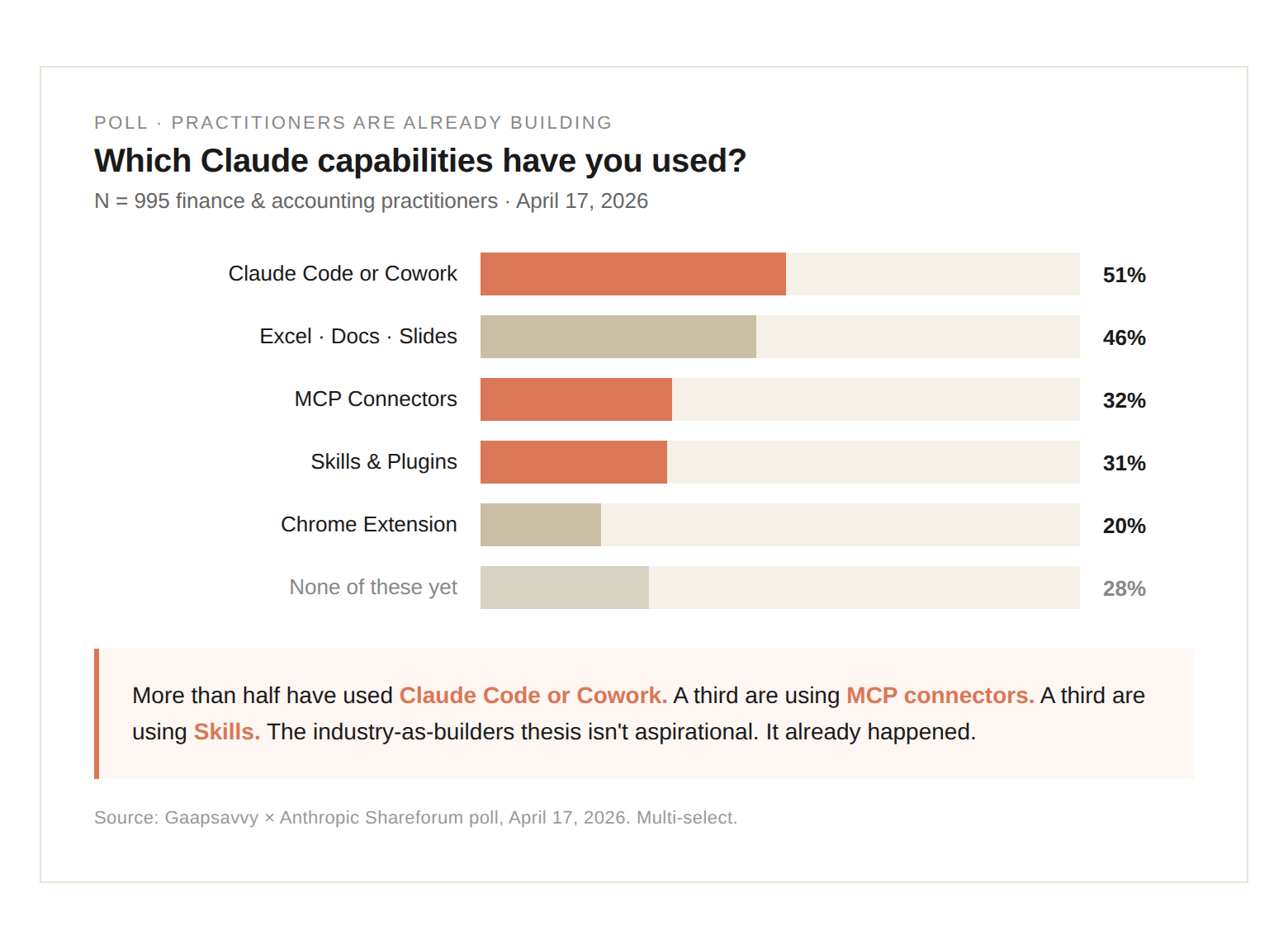
More than half had used Claude Code or Cowork. 46% had used Claude in Excel, Docs, or Slides. A third were using MCP connectors. A third were using Skills.
The “industry as builders” thesis isn’t aspirational. It already happened. Controllers and VP Finance are building. Between meetings. With or without permission.
The activation gap
Here’s what doesn’t fit in either chart on its own. Among in-house practitioners who had Claude approved and answered the capabilities poll — 442 people — 54% had used Claude Code or Cowork. 46% had not. And one in five had used no Claude capability productively at all. Just permission.
That gap is where the profession actually is. The constraint isn’t approval anymore. It’s activation — the distance between “your company said yes” and “you actually built something.” Activation isn’t a product problem. It’s a peer-learning problem. The people who crossed the gap learned it from someone who’d already crossed.
If you’re not one of these builders yet, you’re not behind. You’re early. The community is full of people who started six months ago and people who started six days ago, sitting next to each other in the same room.
Poll three — what practitioners actually want built
Three open text questions, answered by 397 people in a blank text box on a Friday morning. The responses don’t read like a survey. They read like a roadmap.
Clustered into product surfaces, in order of demand: FP&A and reporting (flux, variance, forecasting, exec decks — 61 asks, the single biggest cluster). Close and operational accounting (reconciliations, accruals, journal entries, month-end — 100+ asks combined). Revenue, contracts, and order-to-cash (28 asks). AR, AP, and cash (30 combined). SOX and audit (13 asks). Technical accounting memos (11 asks).
That isn’t a feature list. It’s the org chart of the finance function, mapped to a delivery roadmap. Every cluster maps to a specific team, a specific workflow, a specific monthly pain. And the asks get more specific the deeper you go — not “automate accruals” but “a Xero-to-model reconciliation skill that takes actuals, ties them to your finance model, flags variances by line item, and produces a variance commentary draft.”
These are operators describing what they would build, if they could just figure out how.
This one in particular stood out:
“Sharing the Auto-Accrual MJE Hub and selling that to other companies.”
That last one is from an in-house practitioner who has already built the thing, and whose next instinct is to distribute it. That is the future of this profession in one sentence.
The systems
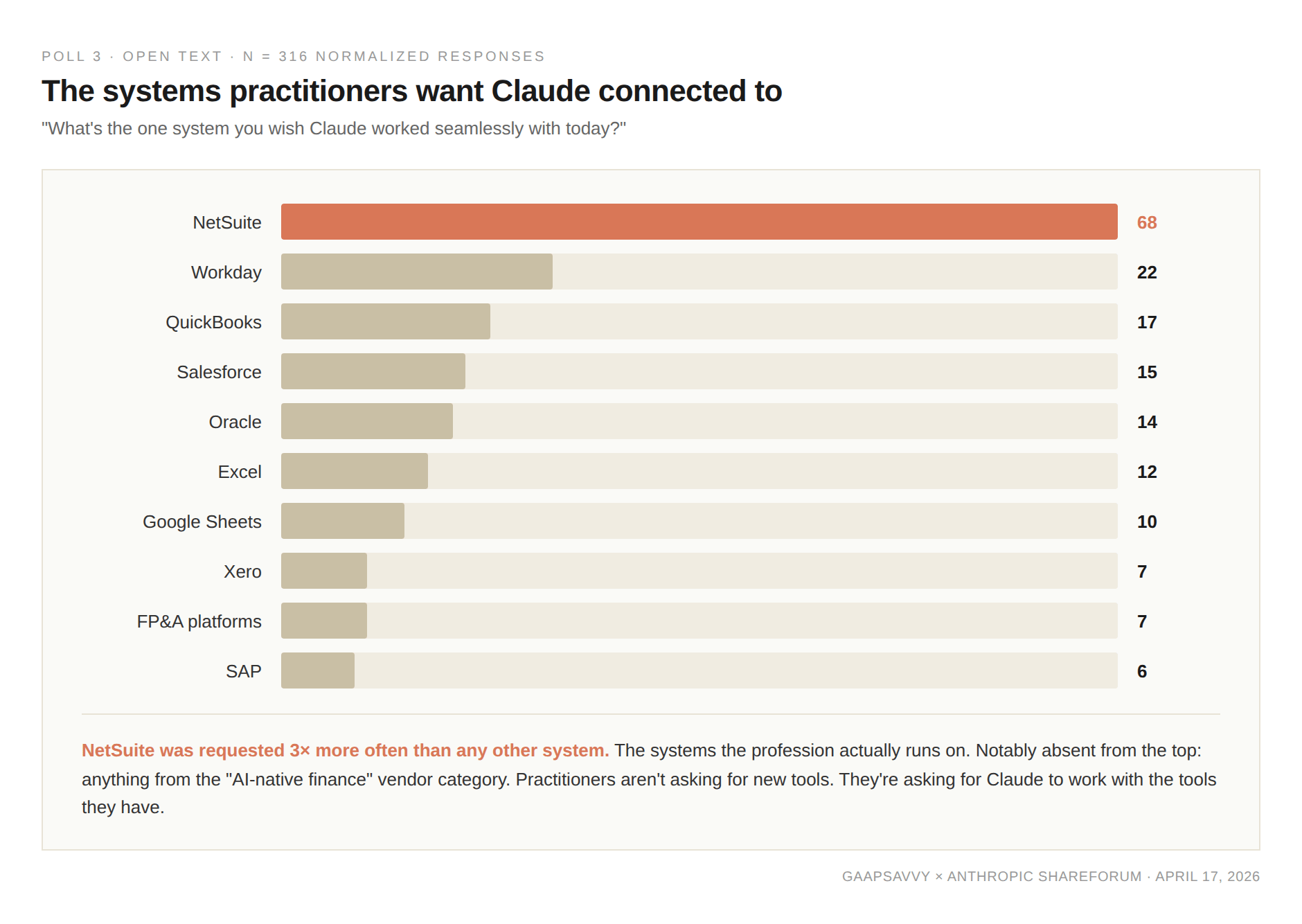
NetSuite was requested 3× more often than any other system. Then Workday, QuickBooks, Salesforce, Oracle. The systems enterprise finance actually runs on. Practitioners aren't asking for new tools — they're asking for Claude to work with the tools they have.
What’s still in their way
The blockers cluster into a shape the article has been arguing all along: training and where to start (27%), time (16%), InfoSec (12%), connectors and integrations (12%), data quality (8%), where builds live (7%), SOX readiness (5%), accuracy and hallucinations (5%). I suspect as teams move access blockers ( training, time and infosec), we will graduate to the deeper problems of data quality, where builds live, SOX and accuracy.
Read it as a sentence. The practitioners aren’t blocked by the technology. They’re blocked by the operational scaffolding around it — the trust, the governance, the integrations, the peer learning, the place where the work lives after you build it. Every one of those is something a community can solve faster than a vendor can.
“Scaling past early adopters. Tooling isn’t the blocker. It’s the change management layer around AI adoption that no vendor owns and every firm underestimates.”
The governance question, asked unprompted
The top-upvoted question in the entire 160-question Q&A, tied at 47, was:
“How does the finance team decide when to use Claude with sensitive finance data, what guardrails are in place, and are there workflows or data types you still avoid using it for?”
The question Zoom couldn’t deduplicate — submitted four separate times, each upvoted to seventeen — was:
“When you create these dashboards, where are they held? This looks brilliant. We are going through the SOX process currently and this looks like such a clean method.”
And further down the list, the question I think will become the question of 2026:
“In finance, we need to audit and recreate past results. How do you use non-deterministic AI tools and still be able to rerun, explain, and stand behind what they produced?”
This is what the practitioner conversation about AI in accounting sounds like when there’s no vendor in the room. Not can it do this. Not is it accurate enough. The questions are about governance, deployment, and reproducibility. The hard problems. The ones nobody has answered.
What this means
Three audiences are reading this section. The data means something different to each.
If you’re a finance leader: Your peers are exactly where you are and further along than you think. 78% approval. 54% active use. 20% with permission but nothing built yet. The distribution is wide because activation depends on whether you’ve seen what’s possible in someone else’s hands. That is what shareforums are for. The next one is the move.
If you build for this audience — software, AI platforms, agents: This is your roadmap. NetSuite first. Reconciliations and accruals as the universal entry point. FP&A and reporting as the volume opportunity. Revenue and contracts where the high-judgment money is. And under all of it, the governance layer that no vendor has solved yet — auditability, reproducibility, where the build lives, how the auditor signs off. The product opportunity isn’t the workflow. It’s the trust scaffolding around the workflow. Whoever builds that first wins.
If you’re a firm or a partner watching this from the outside: The data above did not exist a month ago. It cannot be procured from an analyst firm. It cannot be replicated by a vendor survey. It came out of one room, in 88 minutes, because somebody finally asked the right people the right questions in the right setting. That is what the community produces. The question for partners is whether you want to be in the room when the next set of questions gets asked.
Three weeks later, at the next Gaapsavvy AI session, Sowmya Ranganathan showed us how fast the cycle now runs — demoing a Slackbot her team built that talks to NetSuite, drafts journal entries, and routes them for human review before anything posts. Her architecture principle is the cleanest I've seen: "AI handles language and judgment. Software handles controls and execution." Practitioners come to a venue they trust, builders show what they've shipped, the community absorbs the patterns, and someone in the audience starts building their own version next week. That's the spine.
The thing we accidentally built
Gaapsavvy isn’t a community with sponsors. It’s an ecosystem of living intelligence where the practitioner voice has become valuable to a specific set of institutions — and the relationships look different because what each institution needs is different.
The community produces three things, and partners access any combination depending on what they need.
Access — a room of practitioners that won't otherwise gather. Deloitte and Gaapsavvy hosted our AI Finance Lab together in their San Francisco office. On April 17, 1,312 in-house finance practitioners came because Adam Dix is one of them — a peer with a similar background to the rest of us, a non-coder who started building with Claude on his own time to solve a real problem. He now runs finance ops at Anthropic. The community trusts itself, which is why it can produce a room like that.
Signal — real-time, peer-to-peer, in-the-room signal about what’s actually working, breaking, or being built between meetings. The polling section above is what Signal looks like in operation. No analyst report, vendor survey, or traditional CAB can replicate it, because in those settings participants are performing. In Gaapsavvy they’re not.
Distribution — what we produce together, traveling faster than partner hours and PDFs can carry it. Practitioner-validated interpretations. Governance frameworks. Reusable skills like the Auto-Accrual MJE Hub the respondent above wants to share with other companies. When Gaapsavvy published our EU Data Act analysis last fall, it traveled through practitioner networks and into firm conversations — read by advisors before they walked into client meetings, and cited back to auditors by clients themselves. The community wrote the canon. Distribution happened because what got written was practitioner-aligned. The community as the editor.
One rule unifies all three. The practitioner voice is the asset. Everything else flows from honoring it. Partners who treat it well thrive. Partners who treat it as a sales channel get quietly exposed by the people whose voices they were trying to use. The self-correction is part of the design.
What needs to exist
What needs to exist is a new thing. Not another interpreter. Not another vendor. Not another auditor. A practitioner-governed body whose entire job is to carry signal in two directions.
Up: the wisdom of 1,200 practitioners flowing into the rooms where standards get set, audit frameworks get written, software gets shipped. A seat at the table the profession has never had.
Out: that same wisdom curated into something the profession can use. Not partner hours at partner rates, delivered through a slide deck. Intelligence on tap. Practitioner-validated finance skills — built once, audited by the community, customized to your stack, available at the point of need. The delivery mechanism for wisdom that used to live in partner heads and National Office libraries.
This isn’t a future I’m proposing. It’s a structure that already exists in practice, being asked to formalize itself by the practitioners who built it. The wisdom is theirs. The technology is the carrier.
All of accounting is about memory — how the past affects the future. That’s the whole job. The profession that has kept the world’s memory for 600 years is finally meeting the technology that is learning how to remember. And the canonical memory of professions is being formed in AI right now, in the corpus the models are training on. The professions that don’t show up to write themselves will be misrepresented by the ones who did.
We can either show up and write it together — in community — or we can let it be written for us by the people whose view of the profession has always been partial.
I’ve spent eight years carrying this thesis without the proof. April 17 was the proof.
The community is here. The room is open. Show up and write it with us.
— Angela
What’s coming up:
May 29 — QTC Shareforum. The next Gaapsavvy knowledge share session based on Q&A from the community. In house practitioners only. Join the community here.
June 17 — Gaapsavvy × Zuora: Usage-Based Rev Rec Working Session. In-person, SF. Limited seats — curated for practitioners actively working on usage-based models. This is exactly what this article describes — practitioners and a vendor's product team working through how ASC 606 interpretation adapts to evolving usage models and translating to software builds in real time. Application required. Request an invite.
Partners and platforms thinking about how to plug in to what comes next — find me at angela@gaapsavvy.com.
Great article! You’ve built something special and unique. Exciting to see what’s next!
Great article Angela. I agree that practitioners collaborating will answer the hard questions and move faster than vendors and regulatory bodies. If we can remove the operational scaffolding as you put it, we will achieve the efficiency gains the accounting profession has been begging for the last 50+ years