

Hey there 👋,
I’ve been to a lot of AI events lately. More than usual. Something has shifted since December — and it’s moving at an exponential pace.
Both in the tools. And in the rooms.
It shows up when someone demos what they’ve actually built. When the reality of what’s possible lands in a room full of people who didn’t know it was possible yet. It’s not excitement exactly. It’s quieter than that. A little unsettling. The kind of quiet where everyone is doing the same mental calculation and nobody wants to say it out loud.
I’ve been sitting with that feeling for a few months. Yesterday, I finally got to do something about it.
We ran the largest AI share session we’ve ever done at Gaapsavvy. 670 invites. 160 practitioners showed up — controllers, revenue leads, CAOs from 100+ enterprise tech companies, 90% audited by Big 4 firms. No panels. No vendor demos. Just practitioners telling each other what’s actually happening.
I started the way I always do. With a practice poll.
Your CFO just sent a company-wide email. ‘We’re going all-in on AI for finance by Q2.’
A. Nod confidently, add “AI strategy” to your LinkedIn, and figure out what that actually means later.
B. Raise your hand and ask has anyone actually done this yet? — and watch the whole room go quiet.
80 responses. 90% Big 4 audited. 52% A. 48% B.
I’ll tell you something about that poll: I iterated on the question with Claude for quite some time, trying to get at the heart of it. When the results came in, my co-facilitator Jim said: “This is way more split than I expected.”
My answer: “That’s because we’re pragmatists.”
Both answers are honest. And I feel both, completely.
Here’s what I want to say before we get into the data.
For the first time in my career, the thing standing between accounting teams and what’s possible isn’t the tools, the budget, or even the access. It’s just the learning. That’s both the most encouraging thing I can tell you, and the most demanding.
The models and tools are finally ready. The only thing left is us.
Here’s the thing the accounting world doesn’t hear enough: they didn’t fully work for us before. The tools you’ve been hearing about for two years just became capable enough to actually use. Even if you felt behind. You were waiting for something that wasn’t ready yet. It just became ready. The timeline starts now.
To put some context around the pace: in the last six weeks alone, over 250 model releases across the major labs. Claude’s context window hit one million tokens — your entire contract portfolio, every policy memo, every prior audit conclusion, all loaded at once. Claude Cowork launched, meaning AI can now use your actual computer while you’re in a meeting. Claude Code revenue doubled since January 1st. Engineers have stopped coding without it.
This is not a slow trend you missed. This is a wave that broke last month.
The thing about exponential: it doesn’t feel exponential while it’s happening. It feels like you blinked. The question isn’t whether you’ve caught up — it’s whether you’re learning fast enough to keep up with something that keeps doubling.
That’s what learning in community is really about. Not just sharing use cases. Learning together, fast, in a moment when learning alone is almost impossible.
Let’s dive in.
This article is brought to you by Everest Systems
Most ERPs weren’t designed for AI. They were built for stability — which means when you try to layer automation on top, you’re testing blind, deploying into production, and hoping nothing breaks.
Everest does it differently. AiSpecify lets finance and ops teams build custom apps using natural language — no code, no IT ticket. Live Sandbox lets you test and validate those changes against real data across your systems, before anything goes live.
The frontier models are ready. Now your ERP needs to be too.
What does enterprise finance actually have access to?
Engineering teams have been using frontier models for close to a year. Finance teams at the same companies are just now getting approval.
That gap — same company, different floor — is what the data shows.
Q: What tools does your company actually let you use? ( i.e. IT approved)
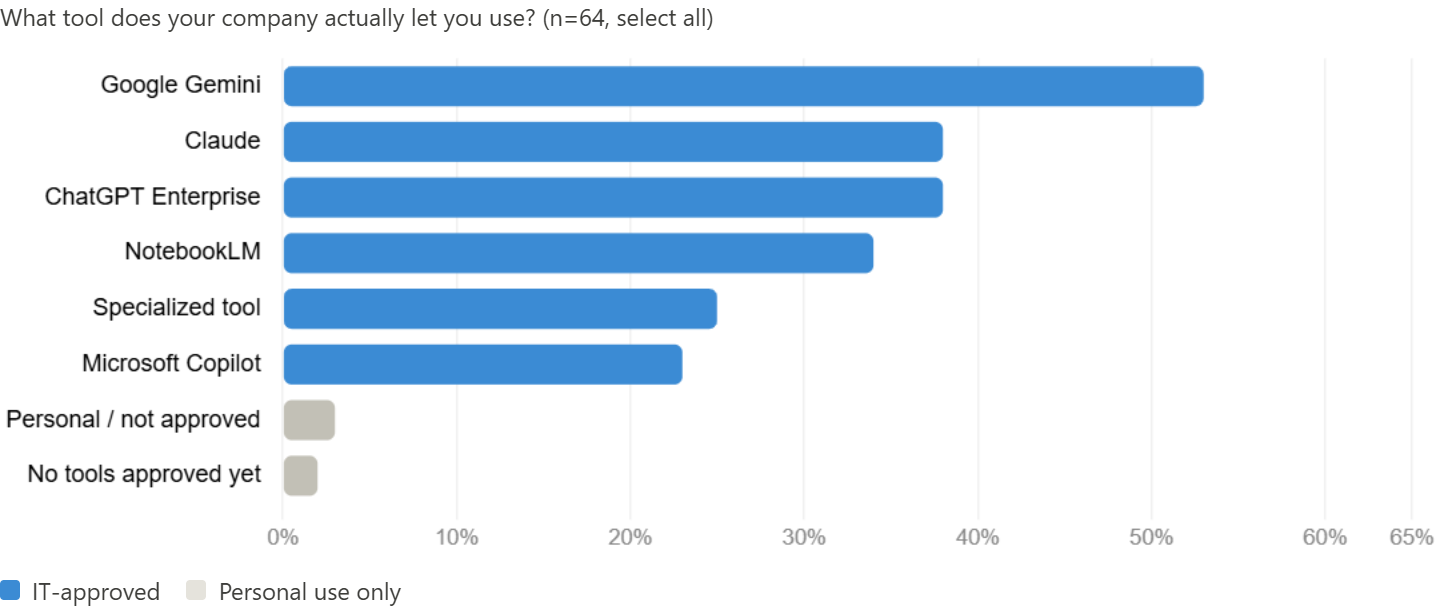
Google Gemini leads at 53% — mostly because it ships with Google Workspace and doesn’t require a separate approval conversation. Claude and ChatGPT Enterprise are tied at 38% each. NotebookLM at 34%. Copilot at 23%.
But the tie between Claude and ChatGPT tells only part of the story.
A migration from ChatGPT to Claude
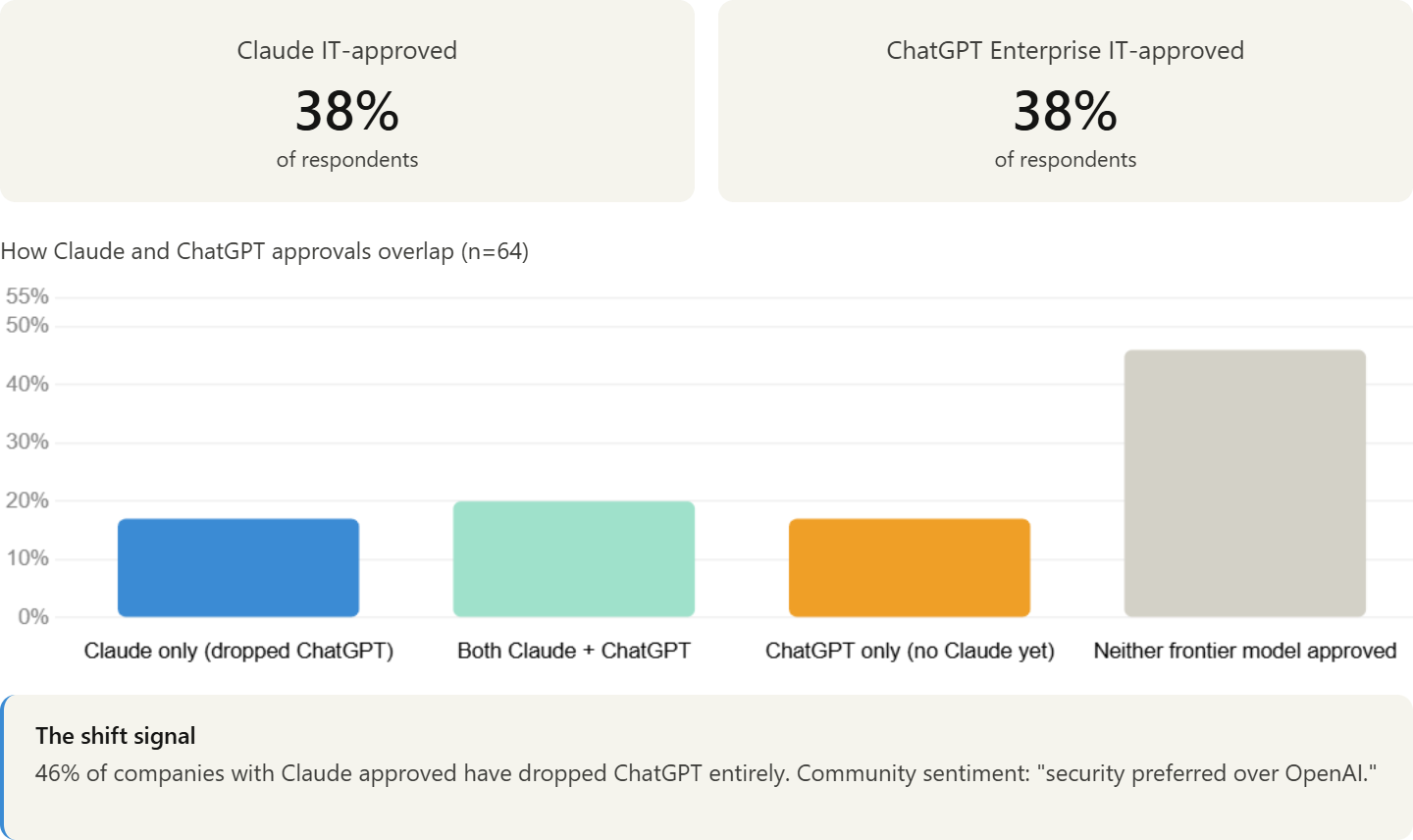
Of companies with Claude approved, 46% have dropped ChatGPT entirely. They didn't add Claude — they replaced ChatGPT with it.
One controller said it directly:
“We had ChatGPT, then moved on to Claude. We don’t have GPT anymore — now it’s just Claude and Gemini.”
Enterprise security teams are making deliberate choices. The data shows which way they're moving.
Worth noting: Anthropic had a rough week — they accidentally leaked Claude Code source code via a packaging error. No customer data involved. Claude Code is the developer CLI engineers use to write code — a different product from Claude Enterprise, which is what your security team is approving. I'm mentioning it because you probably saw the headlines, and that's what we do here.
Getting Claude through InfoSec — some helpful accelerators
For standard Claude: the enterprise agreement is the unlock. Multiple security teams confirmed they got comfortable once a true enterprise agreement was in place. Same with Gemini — one team said IT had concerns about the Pro tier but the enterprise version resolved them immediately.
Claude Cowork is different. It’s currently in beta, and enterprise agreements don’t automatically cover beta products. One team that got it approved described making specific concessions around folder access and going through additional security review. They got there — but it was a longer, more detailed conversation than approving standard Claude.
If you’re trying to get Cowork through InfoSec, go in knowing this. It’s not a blocker. It’s just a different conversation.
And you have standing to have it. 38% of this community — 90% Big 4 audited, 42% already public — has Claude enterprise-approved. Print the chart. That’s your peer group. 👆
What’s actually happening on the ground
Across five share sessions this quarter, 51 documented use cases from 30 companies. The maturity picture: 49% in production. 29% in progress. 12% prototype. The "we're exploring" era is over for most of this community.
What have you done vs. what do you want to crack in the 6 months?
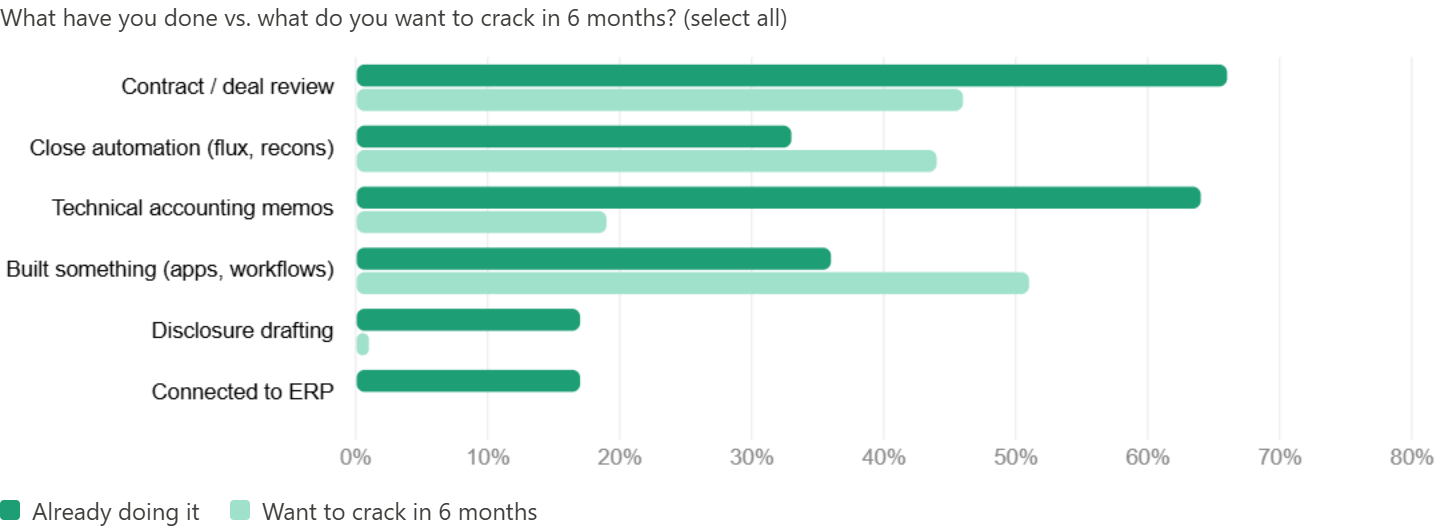
Two-thirds of the room has used AI for contract review or technical memo drafting. There's a reason those two lead: Klarity and Numeric spent years teaching the market that these were the places to start. So when practitioners answer this poll, they're reporting what the industry told them was possible — and what they've now proven works. One-third have built something beyond that. 51% want to build something in the next six months.
One practitioner put the moment perfectly: “Back in the day, everyone had their own Excel workbook. Now we all have our own AI workflows on our desktops.” The proliferation has already happened. The next question — how to centralize, govern, and share — is the same one we asked about spreadsheets. Just ten times faster.
I showed the community what I’ve been building to help organize community shares— an excel use case tracker and an AI index website, both created maintained entirely by Claude Cowork. I don’t populate any of the fields. I drop a transcript into the folder, it populates any new use cases, or tools. Next meeting, another transcript update. The reaction in the chat wasn’t “wow, AI is amazing.” It was quieter. More like: oh. that would make my meetings actually useful.
That shift — from impressed to capable — is the one I’m trying to create every time I show something instead of just describing it.
The conversation kept coming back to the same tension: Finance and engineering are at the same companies, using different languages, sitting on each other's data.
The data layer is the real bottleneck. The most sophisticated teams aren’t stuck on which AI to use. They’re stuck on getting clean data out of engineering. Usage data sits with the AI team. Capitalization data sits with the dev team. Finance is still waiting on monthly extracts. One controller framed it perfectly: “How do we create better data accessibility throughout the organization that we can then put an AI layer on top of?” The AI is ready. The pipes aren’t.
The best reframe I heard all session. Someone pushed back: aren’t these just accounting projects with “AI” in the name? It was exactly the right question. And by the end of the discussion, he’d answered it himself: AI’s highest-leverage use in accounting right now is getting you out of the business of normalizing unstructured data. Five hundred emails. Contracts written in paragraphs. Sales orders that arrive as sentences your shared services team has never seen. The AI handles the transformation so practitioners can do the judgment. That’s not a small thing. That’s the thing that was eating the hours.
Where are you feeling pressure right now?
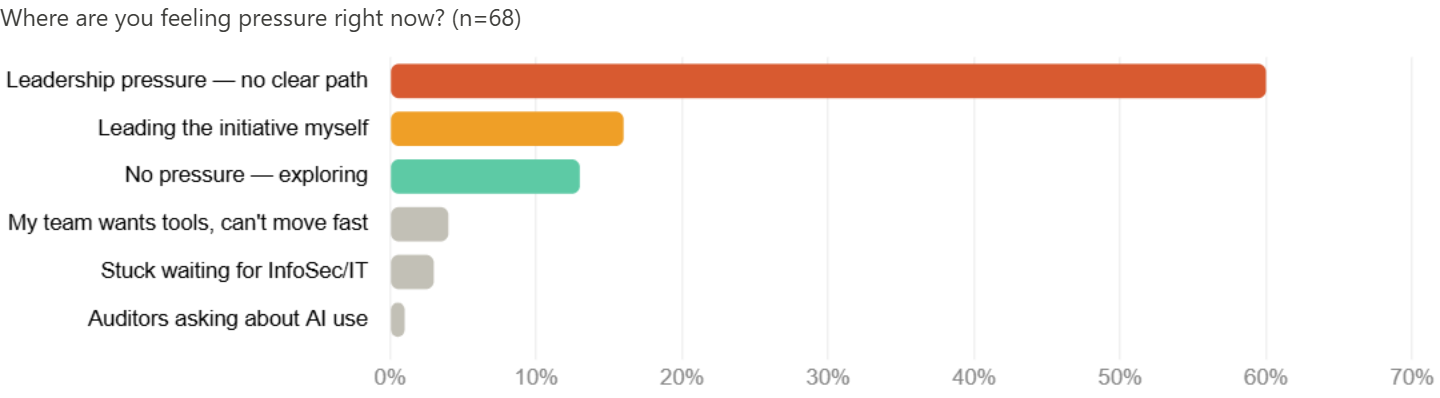
60% are feeling pressure from leadership — with no clear path forward. 16% are leading the initiative themselves. 13% have no pressure at all. Only 3% said they’re stuck waiting for InfoSec.
That surprised me too. The bottleneck people experience as an access problem is usually something else. It’s not knowing what use case to propose. It’s not having data in the right shape. It’s not knowing where to start.
Then someone asked the really hard question: how do we frame KPIs that report up without it sounding like headcount reduction?
The room got a little quiet. Then the expected answers came — speed and accuracy, measured simply. One person with the tool, one without. Time to completion. Error rate. Hours to first draft. Real, measurable, safe to show a CFO.
But here’s the reframe I keep thinking about: at NVIDIA, engineers are literally measured on how many tokens they use. That’s their productivity metric. Accounting doesn't have that language yet — but we're about to need it.
If you’re in the 60%, you’re the norm. The pressure isn’t a sign you’re behind. It’s a sign you’re paying attention.
The one thing AI still can’t do
I was at an event a few weeks ago where a panel was asked: what is the one thing AI can’t do right now?
I didn’t listen to the answers. I already knew mine.
Take responsibility.
AI can generate infinite content. It can normalize unstructured data, draft your memos, build your flux analysis, scour 12 years of Box files to find a variance from 2014. It is getting very, very good at all of it, faster than any of us expected.
But when it gets it wrong — and it will get it wrong — it cannot own that. It cannot stand in front of your auditors and say: this is my judgment, here is my reasoning, and I’m accountable for this conclusion.
That’s still yours. That’s always going to be yours.
I‘ve been thinking a lot lately about what it means to run community in a moment when it is so noisy I can barely hear myself think, when attention is the scarcest resource we have, and when every vendor and consultant and LinkedIn connection is competing for a piece of it.
The thing I keep coming back to: The thing AI can’t do, is show up. It can’t be in the room when the air changes. It can’t notice the silence. It can’t decide, together, to stop performing certainty and start actually sharing.
We are only limited by our capacity to learn. That’s terrifying if you’re trying to do it alone. Not so much if you're not.
We’re in this together. Whether we know it or not. But I think it’s how we’re going to figure it out.
Angela
What’s Coming up:
We’re running two events in April for exactly this reason — one hands-on session at Deloitte SF where you get to actually play, and one where you get to see what it looks like when a team that builds these tools uses them on their own finance problems.
Both are worth your time.
April 15 — AI in Finance Lab half day, in person, hands on session @ Deloitte SF, co-hosted with Coterie CFO. I will be teaching AI Fundamentals, and you have space to play with all the frontier models - FULL
April 17 — “Built Between Meetings: How Anthropic’s Finance Team Actually Uses Claude” virtual with Adam Dix, head of FinOps. Must be a Gaapsavvy community member . No recording. Adam shares his learning journey and demos his builds. Worth it. Join here⭐
Want to see Claude Cowork, Excel plugins, and agentic workflows in action? Devon and I spent an afternoon playing with it and discovering new features — watch here.
From real practitioners, for learning purposes only. Polling data shows industry leans, not final positions. Always work with your auditors before implementing anything new.